A brand we worked with hit 2 million views in 72 hours. Their sales team saw nothing change. The comment section loved the film, the marketing team felt good for a week, and then the quarterly numbers arrived and looked exactly like the quarter before.
Views measure attention. Attention is not a business result. A video can be watched by two million people who never inquire, never book, and cannot name your brand a week later. The gap between a film that looks successful and one that changes a number is decided long before the edit: it is decided by what you agree to measure.
This guide covers:
- What the length of a video does to how much of it people actually watch
- The seven numbers we track on every project, and what each one can tell you
- How to set the measurement up before you spend on production instead of after
How long people actually watch
Video length is the first variable, and the data on it is blunt. Vidyard’s Video in Business Benchmark, built from an analysis of nearly 1 million B2B videos, found that 65% of viewers stay engaged to the end of a video under one minute.
Read that as a budgeting rule rather than a warning against long films. Long films have a job to do, and the job is rarely reach. If your measure of success is how many people finished the video, the length already caps the answer before the shoot starts.
Why a view count cannot carry the result
Views, likes and shares are outputs. They appear when the film entertains, surprises or moves someone, and none of that guarantees a lead, a booking or a recall that influences a purchase later.
We have seen a 200,000-view product film produce zero qualified inquiries. We have also seen a case study film at 4,000 views close a seven-figure client. The second film was built around one question the buyer had, and it was sent to 40 people who were already in the sales conversation.
Intention is the difference. One film was made to perform in a feed. The other was made to move a deal.
The seven numbers we track
Before a shoot, we agree on which of these seven the client will actually look at, and who owns each number on their side. A metric nobody owns is decoration.
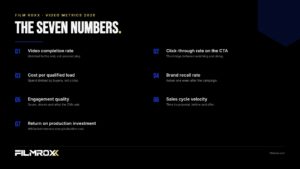
1. Video completion rate. Not how many people pressed play. How many watched to 50%, 75% and 100%. A video with 100,000 views and an 8% completion rate has a problem. A video with 12,000 views and a 62% completion rate is telling you the message landed. Drop-off in the first three seconds means the opening is wrong. Drop-off at 30 seconds means the pacing is wrong, and the curve tells you which.
2. Click-through rate on the call to action. A link, a DM trigger, a form, an on-screen QR code. This is the bridge between watching and doing, and most brands skip it. They produce a strong film, end it with the logo, then wonder why nothing happened next. If the video never says what to do, nothing is what gets done.
3. Cost per qualified lead. Inside a paid campaign this is the number that matters most, and it is not cost per view or cost per click. Take a film that costs Rp 80,000,000 to produce and returns 40 qualified leads. That is Rp 2,000,000 per qualified lead. Compare it to a cheap edit that produces 200 clicks from people who will never buy. The expensive film was the efficient one.
4. Brand recall rate. This one needs a survey, which is why it gets skipped. Ask a sample of your target audience one week after the campaign whether they remember the brand, what the film was about, and what it left them feeling. Luxury and hospitality brands invest in films with no hard call to action for exactly this reason: they are buying a place in the buyer’s mind for the next decision, not a click today.
5. Engagement quality. Qualitative, but it scales. Read the comments and the DMs. Are people asking where to book? Are they tagging the person they would go with? Saves and direct shares are the most honest signals a platform gives you, because they cost the viewer something and put no algorithm between the film and the person. A save from a qualified buyer is worth more than hundreds of passive likes.
6. Sales cycle velocity. Did deals close faster after the film went out? This is the most under-tracked number in B2B video, and it is where a brand film earns its budget. A film placed in a sales conversation shows the prospect who you are before the second call, which shortens the trust-building phase. Ask your sales team to track time-to-proposal and time-to-close on the accounts that received the film, and compare it to the accounts that did not.
7. Return on production investment. Revenue attributed to the campaign divided by total production cost. Most brands do not have the attribution set up, and a rough version still beats nothing. Tag the landing page, use a dedicated phone number, build a UTM link for the video, and the arithmetic becomes possible.
If a number cannot be measured, it cannot justify the next budget, and it cannot tell you what to change in the next film.
What the film has to carry
Measurement starts in the brief, not in the analytics dashboard. Every deliverable needs one job, and that job decides the length, the platform and the ending:
- A social cut has seconds to earn a watch, so it earns it on the first frame
- A brand film has minutes to build recall, so it carries the brand before it carries a price
- A case study film goes into a sales conversation, so it answers the objection the buyer already raised
One production day can serve all three. What it cannot do is serve all three with the same edit, the same length and the same ending.
Three questions we get asked
What counts as a good completion rate? It depends on the length. Under a minute, Vidyard’s benchmark puts average completion at 65%. Over 20 minutes it drops to 20%. Judge the number against the length and the platform first, then against your own history.
How do we measure a brand film with no call to action? With brand recall. Survey a sample of your audience one week after the film runs and ask whether they remember the brand and what the film was about. Recall is the only number that captures what an unbranded-by-design film is buying.
How long before the results mean anything? Watch the first 72 hours for completion and click-through, then read the sales-side numbers at the end of the quarter. Sales cycle velocity and return on production investment do not move inside a week.
Ask this before your next brief
Which of the seven numbers are we tracking, and who on our side owns it? If the answer is views, you are flying blind. You might get lucky once, and luck does not compound.
The teams that get consistent results from video define success before the camera rolls. They know which number the film is built to move, and they brief the shoot around it.
That conversation is where every Film Roxx project starts, before a single shot list exists. If you want to know which number your next film should move, send us the brief and we will tell you what we would measure.